I’m Fat & I Know It
I am 300 lbs. Well, to be completely transparent, I weigh 315 lbs. I am 39 years old. I am a feminist. Outside of the roles I play for my family, that is what you need to know about me. Oh, and I am a writer.
Until recently, I hated my body. I hated the way it was shaped. I hated the way it looked. I hated that my skin sagged around me with fat pockets that mimicked a melting candle in places. I hated that I couldn’t show my arms. I hated that I always wanted to have sex with the lights off or the covers on, so my lovers couldn’t see my body. I hated that I felt I had to apologize to the world for the way I looked.
Then, for some reason, I stopped giving a crap about what other people thought. I realized that my entire life had been marred by the way I perceived myself—the way I was taught to view myself.
The other day, some guy in the grocery store walked by and called me a “fat ass.” In the past, I would have shrunk from the comment, my cheeks flaming and my feet carrying me away as quickly as possible. But not that day. That day, I whipped around, called to the man, and said, “Hey! Yes, I have a fat ass. That is a fact. We can all see that. Is that an insult to you? You insult people by stating the obvious? I don’t walk around referring to you as “little dick," do I? Because I'm sure you are projecting your own inadequacies on me.” He was the one who shrunk that day.
Why should I hide my body? Why should I feel like I have to apologize for the way I look or put up with random comments from men and women just because I exist in their space? I am not a disease. I am not ONLY fat. Fat is just something I also happen to be.
In Lindy West’s book, Shrill: Notes from a Loud Woman, she writes:
“Women matter. Women are half of us. When you raise every woman to believe that we are insignificant, that we are broken, that we are sick, that the only cure is starvation and restraint and smallness; when you pit women against one another, keep us shackled by shame and hunger, obsessing over our flaws rather than our power and potential; when you leverage all of that to sap our money and our time—that moves the rudder of the world. It steers humanity toward conservatism and walls and the narrow interests of men, and it keeps us adrift in waters where women’s safety and humanity are secondary to men’s pleasure and convenience.”
This is so true. We all feel like we have flaws. We all hate parts of our bodies. Why should we be locked in competition? Why should we, as fat women, feel like we are wrong or bad because our flaw is so present and visible to the world?
We shouldn’t.
There are two movements I believe in that many people are against—the Fat Acceptance movement and the Health at Every Size movement. I feel that just like overweight and obese women, these movements are categorically misunderstood by society.
The Fat Acceptance movement (in my belief) means bringing the daily obstacles and hindrances that fat people face in society into the public eye while also showing people that fat people are still people, despite their size, and they also deserve respect.
The Health at Every Size movement (in my belief) encourages people to find healthy living, no matter what their size. They are not saying that at 500lbs, you are healthy and nothing needs to change. They are saying that you can be 500 lbs and find a way to live your best, healthy life.
How are these movements misunderstood by society? Well, the best way to illustrate this would be the recent Telegraph article by Tanya Gold, Obese mannequins are selling women a dangerous lie. The author writes:
Yet the new Nike mannequin is not size 12, which is healthy, or even 16 – a hefty weight, yes, but not one to kill a woman. She is immense, gargantuan, vast. She heaves with fat.
She is, in every measure, obese, and she is not readying herself for a run in her shiny Nike gear. She cannot...
Think about this for a second. Nike, a fitness brand, has started to make plus-size clothing. They’ve now displayed it on a mannequin. Could this be because women of all sizes should be able to access workout clothing, even from mainstream brands? What better place to promote health for women of every size than a fitness brand?
It seems absolutely preposterous to me that people think that adding plus sizes to their clothing catalog in some way makes “being fat okay” or “promotes an unhealthy lifestyle.” God, do you know how much I am sick of hearing assholes say that portrayal of fat women in a positive way promotes an “unhealthy lifestyle”? Tell me something—what healthy lifestyle are you portraying when all of your models are airbrushed and the beauty being thrust into the world is completely unattainable? Women of all sizes should be able to see representation of themselves on screen. Because we are also human and deserve to be seen.
What I see in the writer of this article is a woman who is not happy with herself and therefore has latched on to the fat community as a group of women she can degrade to feel better about herself.
Also, to say a woman of that size cannot run is laughable. This is one of the many falsehoods I see spread regularly about overweight women. If you look up “plus-size running" on Google, here are some of the results:
That last one was from Runner’s World. So…they probably know a thing or two about running.
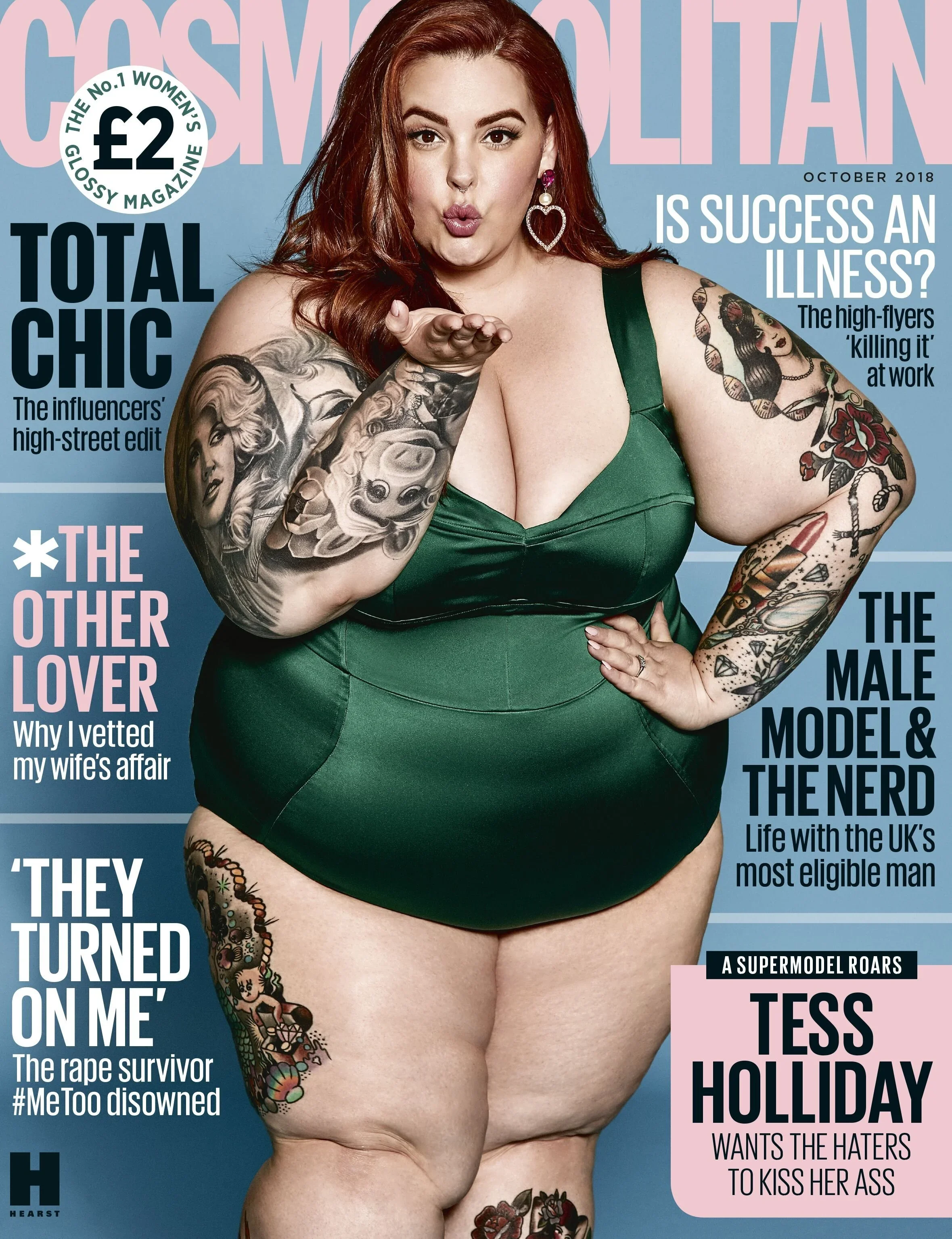
Another example of this would be the response to Tess Holliday’s Cosmopolitan UK cover photo. Critics stated that she was morbidly obese and that the magazine was promoting obesity by having her on the cover.
Tess Holliday had the best response to her critics, though. She stated that her message wasn’t "Let's all be fat." Her message is let's love ourselves. Why is that bad? We exist. The majority of women are overweight or obese. We are allowed to be seen and displayed in the world.
But anyway, I have gotten off topic.
This issue is a feminist issue. Embracing feminism has taught me to accept my body as it is now. To love it and respect it. By doing that, I’ve been able to finally fight the diabetes I have. I’ve changed the way I eat. I’ve started wearing whatever I want, including sleeveless tops that show my arms. I’ve begun accepting that I take up space in the world, that I am a human being, and that I have worth.
One thing that resonated for me was in the Lindy West book mentioned above. She wrote:
“Loving yourself is not antithetical to health, it is intrinsic to health. You can't take good care of a thing you hate.”
― Lindy West, Shrill: Notes from a Loud Woman
If we teach young girls that they should hate their bodies if they are not thin, then we are manifesting a world where eating disorders and body dysmorphia thrive. We are promoting a world of self-hate and hatred of other women who don’t measure up.
Instead, we need to teach girls from a young age to love themselves. We need to teach them to respect themselves. We need to teach them that they are worthy of love and acceptance, no matter what their size. And we need to teach them that their health is important—not their weight, but their health. Because if you are pursuing health, your body will naturally become healthy, no matter what weight you are. And that is what is important.
We can’t smash the patriarchy if we don’t smash the self-hatred first.
So, I’m fat. I know it; you know it. And if you don’t like it, get out of my way.